
Restoring Maltese Stone Walls: Why Limestone Deteriorates and How It Is Properly Repaired
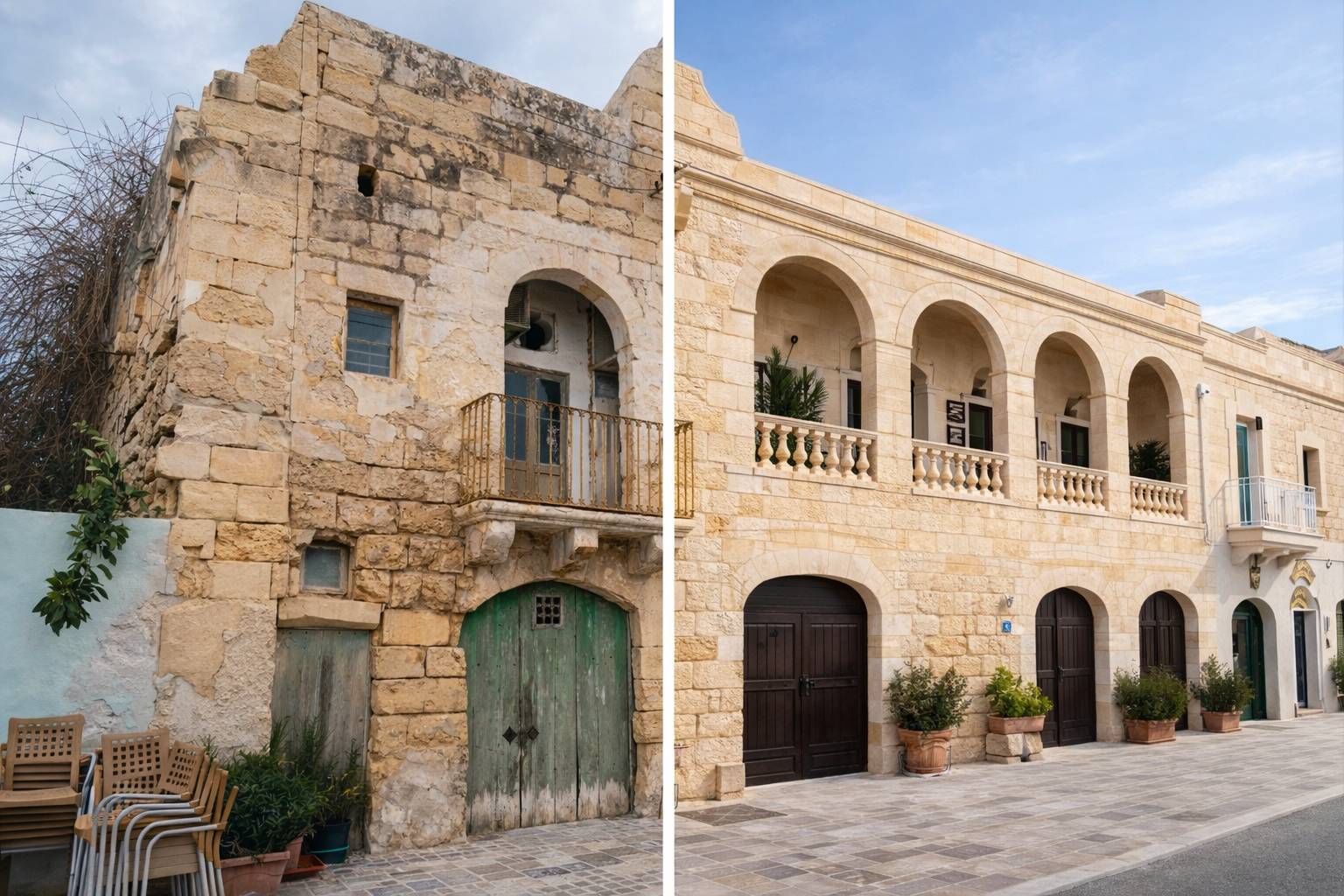
Restoring Maltese Stone Walls: Why Limestone Deteriorates and How It Is Properly Repaired
Maltese stone walls are one of the island’s most defining architectural features. Built primarily from Globigerina limestone and, in some cases, Coralline limestone, these walls have shaped Malta’s urban and rural landscape for centuries. However, despite its beauty and workability, Maltese limestone is a soft and porous material, making it particularly vulnerable to environmental exposure, poor repairs, and moisture-related decay.
Understanding why Maltese stone flakes, powders, and erodes is essential before choosing the correct restoration method. In stone conservation, the wrong intervention can accelerate deterioration rather than stop it.
Why Maltese stone flakes and deteriorates
1. Salt crystallisation and moisture movement
The primary cause of stone decay in Malta is salt crystallisation. Due to the island’s marine environment, airborne salts penetrate limestone pores through wind-driven rain, rising damp, or direct contact with contaminated surfaces. As moisture evaporates, salts crystallise within the stone, expanding and causing surface flaking, granular disintegration, and loss of the stone face.
This process is cyclical and worsens over time if moisture is not correctly managed.
2. Variations in stone quality
Not all Maltese stone performs the same. Different beds of Globigerina limestone vary significantly in density and durability. Softer stone (often referred to locally as soll) deteriorates far more quickly than denser franka, especially on exposed façades, corners, and parapets.
3. Incompatible cement-based repairs
One of the most damaging factors is the historic use of cement mortars and renders. Cement is harder and less breathable than limestone, trapping moisture inside the wall. Instead of evaporating through the joint, moisture and salts are forced through the stone itself—leading to accelerated decay and edge breakdown.
4. Environmental and biological factors
Urban pollution, black crusts, algae, and biological growth retain moisture against the stone surface. Over time, this weakens the limestone matrix and contributes to uneven weathering and staining.
Correct methods for restoring Maltese stone walls
In conservation-led restoration, the guiding principle is always to use the least invasive method necessary, while ensuring long-term durability. Below are the four most common and correct approaches.
1. Repointing with compatible lime mortar
Repointing is often the first and most critical step in restoring a Maltese stone wall.
The process begins by carefully raking out defective or cement-based joints, usually by hand or low-impact tools to avoid damaging the stone arrises. The joints are then cleaned and lightly dampened to control suction.
A lime-based mortar, matched in colour, texture, and porosity to the original masonry, is applied and compacted in layers. Lime mortar allows the wall to breathe, encouraging moisture and salts to migrate through the joint rather than the stone.
In many cases, correct repointing alone can significantly slow further stone deterioration.
2. Plastic repair (stone repair mortar)
Plastic repair is used where damage is localised—such as eroded edges, shallow cavities, spalled faces, or decorative details—while the stone block remains structurally sound.
After removing friable material and cleaning the area, a compatible stone repair mortar is applied in thin layers. The repair is carefully shaped by hand to recreate the original stone profile, texture, and finish.
A properly executed plastic repair is designed to be sacrificial, meaning it weathers before the original limestone. This protects the historic fabric while maintaining the visual continuity of the façade.
3. Re-facing stone or repairing stone cladding
Where the stone face has deteriorated beyond practical patching, or where stone cladding has failed due to moisture ingress or corroded fixings, a more advanced intervention is required.
This process involves removing failed surface material or loose cladding, inspecting the substrate, and addressing the underlying cause—often poor detailing, trapped moisture, or lack of drainage. New stone faces or cladding elements are then installed using compatible bedding mortars or mechanical fixings, ensuring correct ventilation and water shedding.
This method restores both the aesthetic integrity and functional performance of the wall.
4. Replacing a whole kantun or stone block
In severe cases, especially at exposed corners, balconies, or load-bearing edges, the stone may be too deteriorated to repair.
Here, the damaged kantun (quoin) or full stone block is carefully cut out, ensuring adjacent masonry remains stable. A new stone—matched in type, density, orientation, and finish—is prepared and installed using traditional bedding techniques and lime mortar joints.
Although more invasive, full stone replacement is sometimes the only correct and durable solution, particularly where structural integrity is compromised.
A conservation-led approach to Maltese stone restoration
Successful restoration of Maltese stone walls is not about concealing damage—it is about managing moisture, respecting material compatibility, and selecting the correct level of intervention.
When restored correctly, limestone façades can continue to age naturally and gracefully, preserving Malta’s architectural heritage while meeting modern performance expectations.
Planning to restore a Maltese stone wall?
At SULAR Projects, we take a conservation-led approach to limestone restoration—diagnosing the cause of deterioration before specifying the correct repair method. If your property requires repointing, stone repair, re-facing, or full stone replacement, speak to our team for a technical assessment and tailored solution.
Contact SULAR Projects to discuss your stone restoration project.